

Following on from our series of unpacking SUIS-GB’s new Mission, Vision and Values, we now turn our attention to the core values we have agreed upon as a community. This week we will look at ‘Principled’ and what that means in our current context.
在我校全新使命、愿景与价值观的系列解读中,我们陆续和大家分享了校园共同成长的方向与理念。本周,聚焦核心价值观中的重要一项——「恪守准则」,聊聊它在当下教学场景里的真实意义。

Our Assistant Principal and Director of Studies, Mr. Derek Lee, writes about what principled means in the AI era and how we apply ethics and back-to-basics retention methods at SUIS-GB.
助理校长兼教学主任 Derek Lee 先生结合 AI 深度融入学习的时代背景,分享「恪守准则」对师生的价值,并介绍学校践行学术伦理、夯实基础能力的教学实践。
Dr. Fei-Fei Li, the Stanford professor widely recognised as the “Godmother of AI,” has issued a timely warning. She believes the greatest danger of AI in education is not cheating but the erosion of students’ intrinsic motivation to learn. If students rely too heavily on technology, she says, they risk leaving school without having “properly developed the brain” (Li).
斯坦福大学教授李飞飞被公认为”AI教母”,她曾发出一个及时的警告。她认为AI在教育中最大的危险不是作弊,而是侵蚀学生内在的学习动力。她表示,如果学生过度依赖技术,他们可能在离开学校时尚未”充分开发大脑”(Li)。

Our teachers share this concern. While we are fully committed to integrating AI into our curriculum, we feel it must be done responsibly by combining it with time-tested learning methods that engage cognitive effort. For example, we are experimenting with how AI can generate personalised practice questions that adapt to each student’s level, creating AI tutors that guide students through difficult concepts by asking questions rather than giving answers. These 24/7 learning companions could provide step-by-step guidance while preserving the student’s responsibility for their own learning. These approaches demonstrate that AI can extend a teacher’s reach and provide personalised support at scale, but only when it is designed to strengthen critical thinking rather than bypass it.
我们的老师们也有同样的担忧。我们虽然全力致力于将AI融入课程,但我们认为必须以负责任的方式进行,结合那些能够激发认知努力的经典学习方法。例如,我们正在试验如何利用AI生成适应该学生水平的个性化练习题,创建通过提问而非直接给出答案来引导学生攻克难题的AI导师。这些24/7的学习伙伴可以提供逐步指导,同时保留学生对自己学习的责任。这些尝试表明,AI可以拓展教师的覆盖面并提供个性化的支持,但前提是它的设计目的是强化批判性思维,而不是绕过它。
Using AI with Principle 以原则为先的AI使用
When students have unlimited access to AI tools, simply teaching them how to use these tools is not enough. We must teach them to use AI in a principled way. This means students need to take greater responsibility for their own learning, treating AI as a tool that actively benefits their learning rather than a shortcut that replaces thinking. Using AI with principle means students must consciously question AI-generated content, actively engage in processing information, and treat AI as a partner in deepening understanding rather than a means of bypassing cognitive effort.
当学生可以无限制地接触AI工具时,仅仅教他们如何使用这些工具是不够的。我们必须教导他们以原则为先的方式使用AI。这意味着学生需要对自己的学习承担更大的责任,将AI视为一种主动促进学习的工具,而不是替代思考的捷径。以原则为先地使用AI,意味着学生要有意识地质疑AI生成的内容,主动参与信息的处理,并将AI作为深化理解的伙伴,而非绕过认知努力的手段。

Today’s students have never known a world without instant answers. A recent study of 812 experienced Norwegian teachers found that students today show declining concentration, resilience, and intrinsic motivation compared to students from two decades ago. Teachers attribute this to digitalisation, permissive parenting, and a culture of instant gratification. One teacher noted: “Generation Z students are more passive today. They want immediate solutions rather than engaging in the process of learning” (Hatfield 14).
当今的学生从未体验过没有即时答案的世界。近期一项对812名挪威资深教师的研究发现,与二十年前的学生相比,如今的学生在专注力、韧性和内在动力方面均有所下降。教师们将这一现象归因于数字化、过度放任的教养方式以及即时满足的文化氛围。一位教师指出:”Z世代学生更加被动。他们想要即时解决方案,而不是参与学习过程”(Hatfield 14)。
Why Handwriting Must Stay 为何必须保留手写
Research consistently shows that handwriting engages the brain in ways typing cannot. A 2024 study from the Norwegian University of Science and Technology found that handwriting leads to widespread brain connectivity, while typewriting does not produce the same effect (Van der Weel and Van der Meer). Mueller and Oppenheimer’s well-known study demonstrated that students who take notes by hand process information more deeply than those who type. Typists tend to transcribe verbatim, while handwriting forces summarising, synthesising, and reframing in one’s own words (Mueller and Oppenheimer 1165).
研究反复证明,手写在激活大脑方面是打字无法比拟的。挪威科技大学2024年的一项研究发现,手写能够引发广泛的脑部连接,而打字则无法产生同样的效果(Van der Weel and Van der Meer)。Mueller和Oppenheimer的著名研究表明,手写笔记的学生比打字的学生对信息的处理更加深入。打字者倾向于逐字记录,而手写则迫使学生进行概括、综合并以自己的语言重新组织信息(Mueller and Oppenheimer 1165)。
In short, cognitive effort matters. And strong cognitive skills are precisely what students need to use AI effectively.
简而言之,认知努力至关重要。而强大的认知能力恰恰是学生有效使用AI的前提条件。
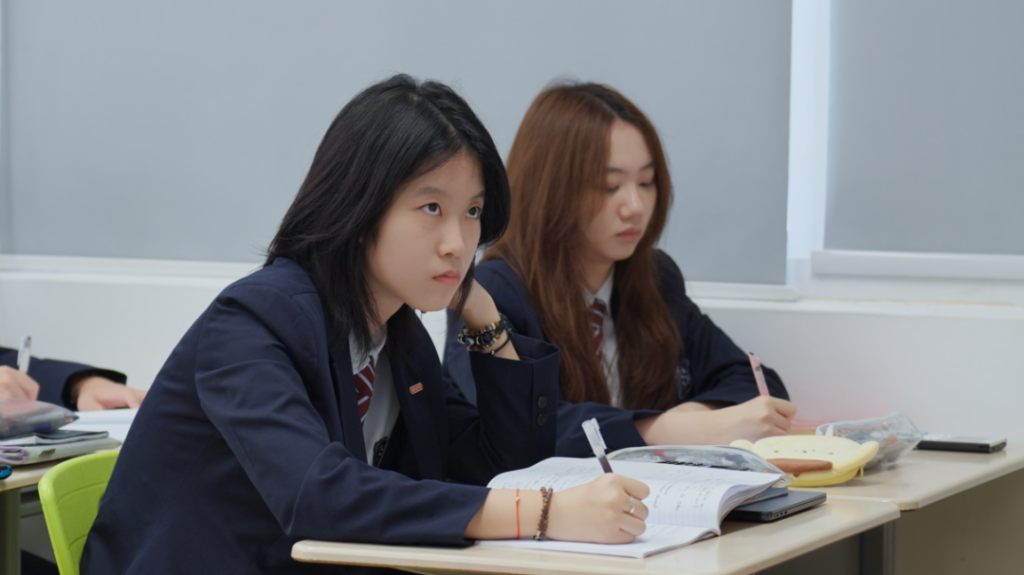
At SUIS Gubei, we teach students to use AI as a learning companion, not a replacement for thinking. But we also insist on methods that build cognitive strength.
在SUIS Gubei,我们教导学生将AI视为学习伙伴,而非思维的替代品。同时,我们坚持采用能够增强认知能力的方法。
We have adopted the Cornell note-taking system as a core practice. This method divides a page into sections for cues, notes, and a summary. It requires students to listen actively, identify key ideas, formulate their own questions, and synthesise content.
我们已将康奈尔笔记法作为核心学习实践。这种方法将页面划分为线索区、笔记区和总结区。它要求学生主动聆听、识别关键观点、提出自己的问题并综合内容。
Students who practise the Cornell method learn to process information, ask better questions, and construct meaning for themselves. These are precisely the skills that make them effective users of AI. As Dr. Li has observed, AI is most useful when a student is already engaged and knows where they are stuck. A student who has developed strong questioning and synthesising skills will use AI as a partner in learning, not a crutch.
实践康奈尔笔记法的学生学会了处理信息、提出更好的问题并为自己构建意义。这些正是使他们成为AI有效使用者的关键技能。正如李飞飞教授所言,AI在学生已经投入学习并知道自己卡在哪里时最为有用。一个已培养出强大提问和综合能力的学生会将AI视为学习中的伙伴,而不是拐杖。
Using AI with principle means students must actively decide when to use AI and how to use it. They need to learn to think for themselves before seeking AI assistance, to critically evaluate AI output after receiving it, and to always keep the ownership of their learning in their own hands. This principled attitude is the core competency students need to succeed in the age of AI.
以原则为先地使用AI,意味着学生要主动决定何时使用AI以及如何使用它。他们需要学会在寻求AI帮助之前先自己思考,在接收AI输出之后进行批判性评估,并始终将学习的主导权掌握在自己手中。这种以原则为先的态度,是学生在AI时代取得成功的核心素养。

Education needs to evolve. AI will shape our children’s future, and they must be fluent in it. But fluency requires a foundation. Dr. Li has said that done well, AI “could make future students way smarter than us” (Li). But that can only happen if students first develop the cognitive muscle to wield AI wisely.
教育需要与时俱进。AI将塑造孩子们的未来,他们必须熟练掌握它。但熟练掌握需要扎实的基础。李飞飞教授表示,如果运用得当,AI”可以让未来的学生比我们聪明得多”(Li)。但这只有在我们首先帮助学生培养出驾驭AI的认知力量时才能实现。
At SUIS Gubei, we are not going backwards. We are moving forward with intention, combining the best of technology with the proven power of traditional learning. We cultivate students who use AI with principle, take responsibility for their own learning, and actively engage in the cognitive process. Our students will graduate AI-fluent, cognitively strong, and principled, ready for a future we cannot yet imagine.
在协和古北,我们并非在倒退。我们带着明确的意图向前迈进,将最前沿的技术与经典学习方法的可靠力量相结合。我们培养学生以原则为先地使用AI,对自己的学习负责,主动参与认知过程。我们的学生将以AI熟练、认知强大且富有原则的姿态毕业,准备好迎接一个我们尚且无法想象的未来。
Works Cited 引用文献
Hatfield, Johannes Lunde. “From Chalkboard to Smartboard: An Exploratory Study of Experienced Teachers’ Perspectives on Student Generations X, Y, Z and Alpha.” Education and Information Technologies, vol. 30, 2025, pp. 22595-22647.
Li, Fei-Fei. Interview. The AI Conference, 2024.
Mueller, Pam A., and Danny M. Oppenheimer. “The Pen Is Mightier Than the Keyboard: Advantages of Longhand Over Laptop Note Taking.” Psychological Science, vol. 25, no. 6, 2014, pp. 1159-1168.
Van der Weel, F. R., and Audrey L. H. Van der Meer. “Handwriting but Not Typewriting Leads to Widespread Brain Connectivity.” Developmental Neuroscience Laboratory, NTNU, 2024.
▲ Written by Mr. Derek Lee, Assistant Principal and Director of Studies